A chicken coop auto door is a machine that still needs a person
Chicken coop auto doors, and chicken coop doors in general, are only as good as the opening they close, the power they use, and the habit you keep of looking at the flock. An automatic door can take a daily chore off your hands. It cannot replace a glance to see whether a bird is outside, whether the door actually closed, or whether a predator is testing the frame. This is a buyer's checklist, not a product test, and not a veterinary article.
The door is part of a larger housing system. Extension services still want a secure run, sensible space, and ventilation that does not draft the roost. See Penn State Extension, Small Scale Poultry Housing and OSU Extension, Backyard Chicken Coop Design for those basics. Buy the door after you know the hole it must cover.
Types, power, and what to inspect
| Feature |
What to compare |
A failure mode to plan for |
| Opening size |
The pop hole plus a little clearance, measured, and the door's claimed coverage |
A door that does not fully cover the opening, or binds on a warped frame |
| Drive |
Vertical drop, sliding, or another mechanism the seller describes clearly |
A mechanism that jams with bedding, ice, or a curious beak |
| Power |
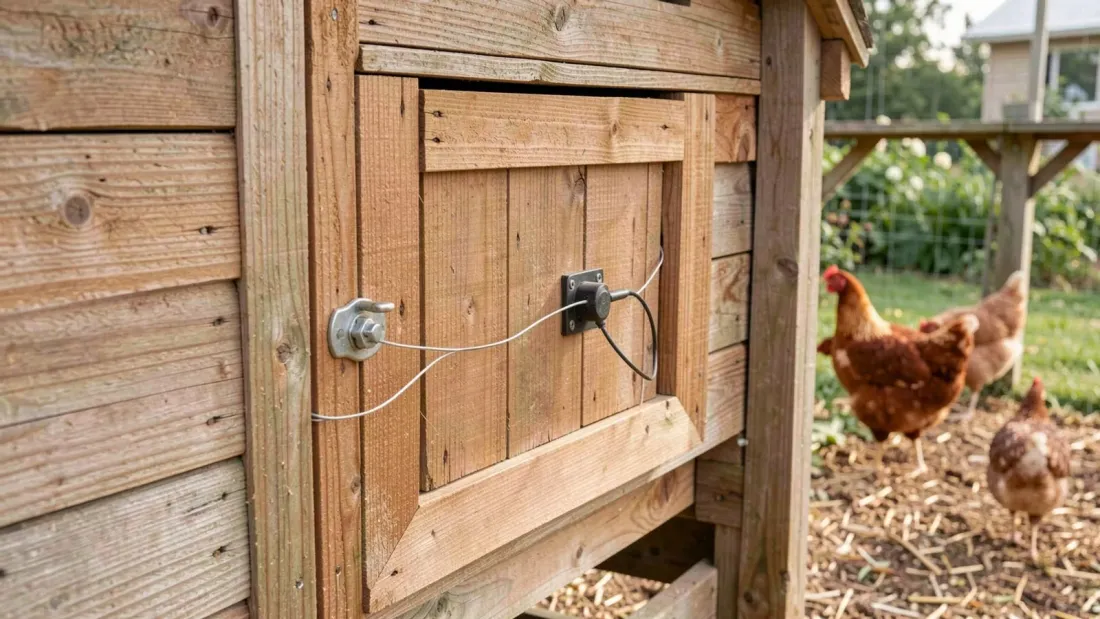
Mains with a safe, weather-sensible installation; battery; or a solar kit you can actually site in sun |
A dead battery after a string of dark days, with no manual way to shut the door |
| Trigger |
Timer, light sensor, or a combination you can understand and override |
A light sensor fooled by a barn light, or a timer that does not change with the season unless you change it |
| Manual override |
A way to open and close the door with your hand when power or electronics fail |
A unit that cannot be moved when it has failed closed or failed open |
| Construction |
Materials that will take weather, and a frame you can mount square |
Thin plastic in a freezing climate, or screws into rotten wood |
| Safety |
Whether the door can pinch a bird, and whether it locks against a predator |
A door that rests shut but does not resist a raccoon or a determined dog |
| Alerting |
Whether you can tell, from a distance or a routine, that it closed |
Assuming silence means success |
A chicken coop door that you operate by hand should still close firmly, resist pests, and be easy to use in the dark. An automatic unit that cannot match those basics is not an upgrade.
A buyer's checklist for chicken coop auto doors
- The pop hole is measured, and the door covers it fully
- The frame is sound, square, and will take the mounting hardware
- You understand the power source and have a manual close
- You understand the trigger, and you can change it as daylight changes
- You have a plan for ice, bedding, and debris in the track
- You will still walk out to look at the birds, especially at dusk and after storms
- Predator resistance is a feature of the whole opening, not only a motor
- Spare batteries or a charging plan exists, if the unit needs them
- Installation will not block ventilation or create a draft on the roost
- Local electrical rules will be followed if you use mains power; hire a qualified person if you are not one
If you cannot tick the manual close and the habit of looking, postpone the purchase. The flock still needs a closed door.
What an auto door will not do
It will not count the birds in. It will not treat a sick bird. It will not fix a hole in the run mesh. Oregon State Extension's guidance on covering the run and burying fencing still applies. Penn State's notes on dry, well-drained housing still apply. Automating the pop hole is a convenience around those jobs, not a replacement for them.
In winter, look at the track. In summer, look at the power. After any failure, look at the birds first, then at the unit.
Fitting the door to an existing coop, neatly
Measure twice: the hole, the flatness of the wall, and the swing or drop path, including snow, a ramp, and a bird on the threshold. A unit designed for a thin wall may not like a double-wall coop, and the reverse. Read the mounting diagram before you pay.
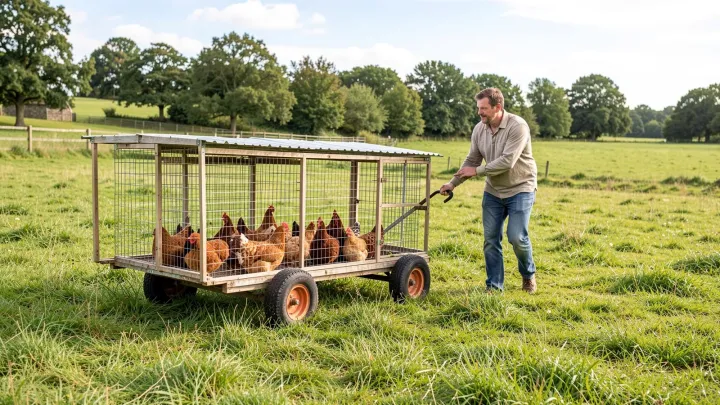
If you later want a chicken coop mover or a tractor, think about whether wires, solar panels, and doors will survive a move. A beautifully installed auto door can be a nuisance if the whole house is going to change sites every week. In that case, a robust manual door, or a unit designed to be moved, is the more practical automatic plan.
Keep a spare pin, a spare battery if relevant, and the manual in the same dry tin as other coop tools. A 9 p.m. failure is a poor time to search a download only available on the house wifi.
Power, batteries, and a winter week
Write down the power plan in one sentence you could explain in the dark. If it is mains, the installation must be safe and weather-sensible, and a qualified person should do work you cannot do lawfully or confidently. If it is a battery, put a reminder on the same calendar as feeder checks. If it is solar, look at the panel in the real winter sun, not in a June photograph, and keep the panel out of the reach of curious beaks and of falling snow where you can.
A week of late dusks, short days, and a tired battery is a common failure story. The antidote is a manual close you have already practiced and a habit of looking. Convenience that fails closed with a bird outside, or fails open overnight, is not convenience.
Shop names will offer "smart" features. Treat them as extras. The door must close, stay closed, and open again in the morning, on a wall you have already prepared.
Questions about chicken coop auto doors
Do I need an automatic door if I am home at dusk?
No. A solid manual door, closed as part of a routine, is complete. An automatic door is for people whose day does not reliably match dusk, or who want a backup on late evenings, not a requirement of good keeping.
Is a light-sensor door better than a timer?
Neither is automatically better. A light sensor can follow the season and can also be confused by stray light. A timer is predictable and must be adjusted as daylight changes. Choose the one you will actually manage, and keep a manual override.
Can an auto door close on a chicken?
It can, if a bird is in the opening. Look for a design that is less likely to pinch, teach the flock the closing time as much as you can, and check the doorway. No listing should be treated as impossible to fail.
Will an automatic door keep predators out by itself?
Only if the door, the frame, the locks, and the rest of the coop and run are already predator-resistant. A motor is not a substitute for mesh, buried fencing, and a sound latch when the door is down.